

suzuki method violin book 1 pdf
Suzuki Violin Method Book 1: A Comprehensive Guide
Suzuki Violin Book 1‚ published in 2016‚ offers foundational pieces like “Twinkle‚ Twinkle.”
Accessing a PDF version allows convenient study and practice‚
supplemented by piano accompaniment and CD recordings.
The Suzuki Method‚ a revolutionary approach to music education‚ centers on learning by ear‚ mirroring language acquisition. Founded by Shinichi Suzuki‚ it emphasizes creating a nurturing environment and fostering a love for music from a young age. Suzuki Violin Book 1 serves as the cornerstone for beginners‚ introducing fundamental techniques through carefully selected pieces.
Unlike traditional methods focusing on sheet music initially‚ the Suzuki approach prioritizes developing a beautiful tone and accurate intonation through listening and imitation. Students learn pieces like “Twinkle‚ Twinkle‚ Little Star” variations‚ gradually building skills. A PDF version of Book 1 provides accessible practice material‚ often accompanied by piano accompaniment recordings to aid in correct rhythm and phrasing. This method isn’t just about playing the violin; it’s about character development and cultivating sensitivity.
What is Suzuki Violin Book 1?
Suzuki Violin Book 1 is the initial volume in a renowned series designed for beginning violinists following the Suzuki method. Published by Alan OHashi in 2016‚ it contains a selection of traditional tunes arranged for easy learning‚ starting with variations of “Twinkle‚ Twinkle‚ Little Star.” A readily available PDF version facilitates convenient access to the music and exercises.
This book isn’t merely a collection of songs; it’s a structured curriculum. It introduces basic musical concepts gradually‚ focusing on developing aural skills and proper technique. The PDF often complements CD recordings and a piano accompaniment book‚ essential for accurate practice. Students progress through pieces like “Lightly Row” and “Song of the Wind‚” building a solid foundation for more advanced repertoire. It’s a complete package for early violin education.
History of the Suzuki Method
The Suzuki Method‚ founded by Shinichi Suzuki‚ stems from the belief that musical ability‚ like language‚ is best developed early through immersion. Observing how children naturally acquire their native tongue‚ Suzuki theorized a similar approach could unlock musical potential in all. He began developing his method post-World War II‚ aiming to nurture character and create a harmonious society through music.
The method emphasizes listening‚ repetition‚ and a supportive learning environment. Suzuki Violin Book 1‚ a cornerstone of this approach‚ embodies these principles. Accessing a PDF of the book allows students to engage with the core material. The method’s success led to its global adoption‚ with teachers worldwide utilizing the sequential volumes‚ including the foundational Book 1‚ and accompanying resources like CD recordings.

Understanding the Content of Book 1
Suzuki Violin Book 1’s PDF features classic tunes like “Twinkle‚ Twinkle‚” “Lightly Row‚” and “Go Tell Aunt Rhody‚” building skills progressively through repetition and variation.
Twinkle‚ Twinkle‚ Little Star Variations
Suzuki Violin Book 1’s PDF prominently features numerous variations of “Twinkle‚ Twinkle‚ Little Star.” This isn’t merely rote learning; it’s a cornerstone of the Suzuki method. Students don’t just learn the melody‚ but explore it through diverse rhythmic and tonal interpretations. The PDF allows for easy access to these variations‚ enabling focused practice.
These variations build fundamental skills – intonation‚ bow control‚ and left-hand finger placement – in a musically engaging way. The accompanying piano accompaniment‚ often found within the PDF or as a separate book‚ is crucial for developing a sense of rhythm and phrasing. The iterative nature of these variations reinforces learning and builds confidence‚ preparing students for more complex pieces later in the book. Mastering these early variations is vital for success.
Lightly Row
Following “Twinkle‚ Twinkle‚” Suzuki Violin Book 1’s PDF introduces “Lightly Row.” This piece builds upon the foundational skills established with the earlier variations‚ introducing a new melodic contour and rhythmic pattern. The PDF format facilitates close study of the sheet music‚ allowing students to analyze the bowing and fingering.
“Lightly Row” emphasizes smooth bow changes and consistent tone production. The piano accompaniment‚ readily available alongside the PDF‚ provides a supportive harmonic framework and rhythmic guide. Students learn to coordinate their left and right hands more effectively‚ developing musicality and expression. Practicing with the CD recordings included with the method further enhances aural skills and provides a model for accurate performance. This piece is a stepping stone to more challenging repertoire.
Song of the Wind
Within the Suzuki Violin Book 1 PDF‚ “Song of the Wind” presents a lyrical and expressive melody. This piece builds upon previously learned techniques‚ demanding greater control of bowing and intonation. Students utilizing the PDF can meticulously examine the fingerings and bowing indications‚ fostering independent learning.
“Song of the Wind” encourages a more legato style‚ emphasizing a connected and flowing sound. The accompanying piano accompaniment‚ accessible alongside the PDF‚ provides harmonic support and rhythmic stability. Listening to the CD recordings included with the method is crucial for internalizing the phrasing and musical character. This piece introduces subtle dynamic variations‚ enhancing musical interpretation and developing a sensitive approach to the violin. It’s a beautiful and rewarding piece for young violinists.
Go Tell Aunt Rhody
“Go Tell Aunt Rhody‚” featured in the Suzuki Violin Book 1 PDF‚ introduces students to a familiar folk tune with a slightly more complex rhythmic structure. The PDF format allows for detailed study of the sheet music‚ focusing on accurate note reading and consistent rhythm. Students can benefit from repeatedly reviewing the piece within the digital document.
This song reinforces the use of the first finger on the A string and introduces simple shifting concepts. Utilizing the piano accompaniment alongside the PDF helps students internalize the harmonic context and maintain a steady tempo. Listening to the corresponding track on the CD recordings provides a model for phrasing and articulation. “Go Tell Aunt Rhody” is a fun and engaging piece that builds confidence and musicality.
Long‚ Long Ago
“Long‚ Long Ago‚” a cornerstone of Suzuki Violin Book 1‚ is readily accessible within the PDF version‚ offering students a beautiful and lyrical melody. The PDF format enables focused practice on intonation and smooth bow changes‚ crucial for mastering this piece. Students can zoom in on the notation for precise finger placement and bowing instructions.
This song expands upon previously learned techniques‚ introducing more sustained notes and expressive phrasing. The piano accompaniment‚ available alongside the PDF‚ provides harmonic support and encourages musical interpretation. Utilizing the CD recordings allows students to emulate the correct tone and style. “Long‚ Long Ago” cultivates a sense of musicality and builds a strong foundation for future repertoire.

Technical Aspects & Skills Developed
Suzuki Violin Book 1’s PDF fosters proper posture‚ bow hold‚ and left-hand technique.
It introduces basic music reading‚ rhythm‚ and timing‚ building a solid foundation.
Proper Violin Posture
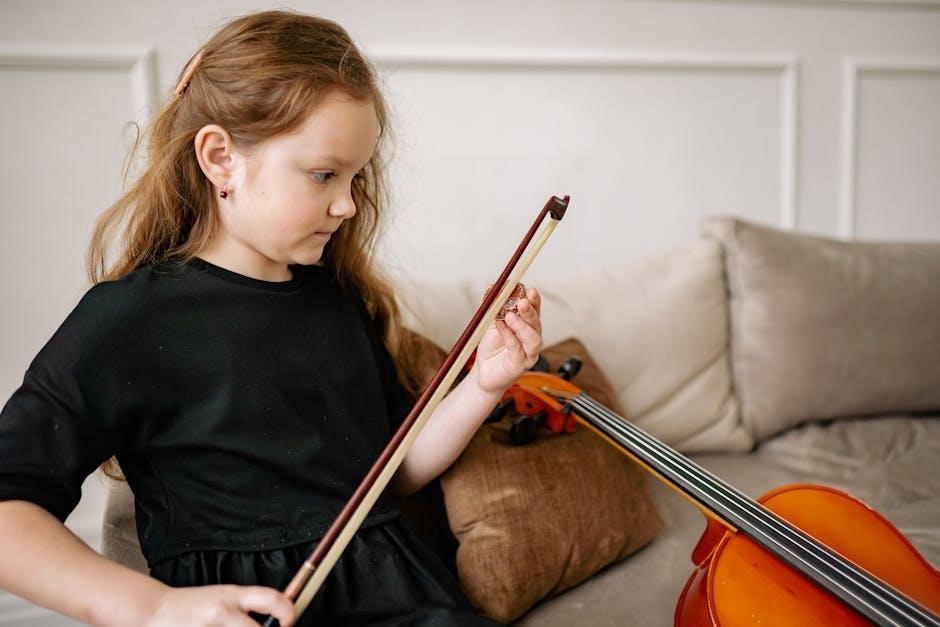
Suzuki Violin Book 1‚ often accessed as a PDF‚ emphasizes correct posture from the very beginning. This foundational element is crucial for preventing injury and maximizing playing efficiency. Students learn to stand or sit with a straight back‚ relaxed shoulders‚ and a balanced weight distribution.
The violin is held securely between the collarbone and the shoulder‚ utilizing a shoulder rest for comfort and support. A proper head position‚ avoiding tension in the neck‚ is also stressed. The PDF format allows students to repeatedly review diagrams illustrating the ideal posture.
Developing good posture early on‚ as guided by the Suzuki method and its materials‚ establishes a strong physical base for more advanced techniques. Consistent attention to posture‚ even during practice with the PDF‚ is key to long-term success.
Bow Hold and Technique

Suzuki Violin Book 1‚ readily available as a PDF‚ introduces a relaxed and flexible bow hold. Students learn to curve their fingers naturally around the bow‚ avoiding tension that hinders control. The thumb plays a vital role in providing support and balance‚ while the index finger contributes to articulation.
Early exercises focus on producing a smooth‚ consistent tone by drawing the bow straight across the strings. The PDF often includes illustrations demonstrating the correct hand position and bow angle. Developing a good bow technique is paramount‚ as it directly impacts sound quality.
The Suzuki method emphasizes listening and imitation‚ encouraging students to model the bowing demonstrated in accompanying CD recordings. Consistent practice‚ guided by the PDF’s visual aids‚ builds muscle memory and refines bow control.
Left-Hand Finger Placement
Suzuki Violin Book 1‚ often accessed as a PDF‚ meticulously guides students through accurate left-hand finger placement. Initial focus centers on establishing a relaxed and curved hand shape‚ avoiding tension that impedes intonation. The PDF frequently features diagrams illustrating precise finger positions for each note.
Students learn to identify intervals by ear and then locate corresponding finger placements on the fingerboard. The Suzuki method prioritizes developing a strong sense of pitch‚ aided by repeated listening to CD recordings.
Exercises within the PDF emphasize slow‚ deliberate finger movements‚ ensuring accuracy before increasing speed. Consistent practice‚ coupled with attentive listening‚ builds muscle memory and cultivates confident‚ in-tune playing.
Reading Music Basics in Book 1
The Suzuki Violin Book 1 PDF introduces fundamental music reading skills gradually. Initially‚ the focus isn’t on immediate note recognition‚ but rather on developing a strong aural understanding through repeated listening to the included CD recordings. Students learn to associate sounds with written symbols.
The PDF progressively introduces basic notation – the staff‚ clef‚ and note values – alongside familiar melodies like “Twinkle‚ Twinkle‚ Little Star.” Emphasis is placed on recognizing patterns and intervals rather than isolated notes.
Rhythm is also introduced simply‚ with exercises designed to internalize basic time signatures and note durations. The Suzuki method prioritizes learning by ear‚ with notation serving as a reinforcement tool.
Rhythm and Timing Exercises
The Suzuki Violin Book 1 PDF incorporates rhythm and timing exercises intrinsically linked to the pieces themselves. “Twinkle‚ Twinkle‚ Little Star” variations‚ for example‚ aren’t just about pitch; they subtly introduce rhythmic variations and phrasing.
Students using the PDF will find that repetition is key. Playing the same passages multiple times‚ guided by the CD recordings‚ helps internalize a steady beat and develop a natural sense of timing. The piano accompaniment further reinforces rhythmic accuracy.
While formal rhythmic counting isn’t immediately emphasized‚ the method encourages students to feel the pulse. The Suzuki approach prioritizes musicality over strict adherence to notation initially‚ fostering a natural rhythmic flow.

Finding and Accessing the PDF
Suzuki Violin Book 1 PDF versions are available online‚ but verifying legality is crucial. Numerous sources offer downloads; proceed with caution and diligence.
Where to Download Suzuki Violin Book 1 PDF
Locating a Suzuki Violin Book 1 PDF requires careful navigation of online resources. Several websites claim to host the complete volume‚ often presented as a “completo” edition. A flip PDF version‚ as noted from October 10‚ 2016‚ provides a page-turning experience‚ allowing previewing before download.
However‚ be aware that not all sources are legitimate. Some may offer incomplete versions or contain malware. Searching for “Suzuki violin method vol 01 PDF WITH TEXT download” can yield results‚ but always scan downloaded files with antivirus software.
Exploring online music education platforms and digital sheet music stores is also advisable. While a free‚ legal download can be challenging to find‚ these platforms often offer affordable access to the book and accompanying materials. Remember to prioritize reputable sources to ensure a safe and quality learning experience.
Legality of PDF Downloads
The legality of downloading a Suzuki Violin Book 1 PDF is a crucial consideration. Copyright laws protect the intellectual property of the publisher and author. Downloading a PDF from unofficial sources‚ particularly those offering it for free without authorization‚ constitutes copyright infringement.
While finding a free PDF might seem tempting‚ it’s ethically and legally questionable. Purchasing the physical book or a licensed digital version supports the creators and ensures continued production of valuable educational materials.
Authorized retailers and the publisher’s official website are the safest and most legal avenues for obtaining the book. Be wary of websites offering “free” downloads‚ as these often violate copyright and may expose you to security risks. Respecting copyright fosters a sustainable environment for music education.
Reliable Sources for the PDF
Finding a legitimate Suzuki Violin Book 1 PDF requires careful sourcing. Directly purchasing from the publisher’s official website is the most secure option‚ guaranteeing a legal and high-quality file. Reputable online music retailers‚ such as Sheet Music Plus or similar platforms‚ often offer licensed digital downloads.
Consider exploring digital libraries affiliated with educational institutions; they may provide access to the book for enrolled students. Avoid websites promising “free” PDFs from unknown sources‚ as these frequently contain malware or copyright-infringing material.
Always verify the source’s credibility before downloading. Look for secure payment gateways and clear copyright information. Prioritize legal acquisition to support the creators and ensure a safe digital experience.

Using the Suzuki Violin Book 1 PDF Effectively
Suzuki Violin Book 1’s PDF format enables easy navigation‚ printing‚ and annotation for focused practice. Utilize digital tools to enhance learning!
Navigating the PDF Document
Successfully utilizing the Suzuki Violin Book 1 PDF requires understanding its features. Most PDF readers‚ like Adobe Acrobat‚ offer a table of contents for quick access to specific pieces – “Twinkle‚ Twinkle” variations‚ “Lightly Row‚” and others.
The search function is invaluable for locating specific terms or musical concepts. Zooming capabilities allow for comfortable viewing on various screen sizes. Hyperlinks‚ if present in the PDF‚ will direct you to related resources or sections.
Familiarize yourself with the PDF’s bookmarking feature to save frequently accessed pages. Consider using the page thumbnail view for a visual overview of the entire book. Efficient navigation maximizes practice time and enhances the learning experience with this foundational material.
Printing Considerations
Printing the Suzuki Violin Book 1 PDF requires careful consideration to conserve resources and ensure readability. Before printing‚ review the document to select only necessary pages – perhaps focusing on one song at a time. Choose “Print as Booklet” if your printer supports it‚ creating a bound‚ book-like format.
Opt for double-sided printing to halve paper consumption. Adjust the scaling to “Fit” the page‚ preventing content from being cut off. Black and white printing is sufficient for most musical notation‚ saving color ink.
Consider the paper quality; heavier weight paper will withstand frequent handling. Remember that printing incurs costs‚ so digital access remains a sustainable alternative for regular study.
Annotation and Note-Taking
Utilizing the Suzuki Violin Book 1 PDF for effective learning benefits greatly from annotation. Most PDF readers allow highlighting key passages – fingerings‚ bowing instructions‚ or rhythmic patterns. Add text boxes for personalized reminders‚ such as practice goals or teacher’s notes.
Employ the drawing tools to mark specific notes or sections needing extra attention. Create custom stamps for frequently used symbols‚ like dynamics or articulations. Digital notes are non-destructive; you can always erase or modify them.
Regular annotation transforms the PDF from a static document into a dynamic learning tool‚ fostering deeper engagement and retention.
Supplementary Materials
Suzuki Violin Book 1 is enhanced with a piano accompaniment book and CD recordings.
These resources‚ alongside online tutorials‚ support learning from the PDF.
Piano Accompaniment Book
The Piano Accompaniment Book is an essential companion to the Suzuki Violin Book 1 PDF. It provides the precise musical backing needed for students to develop accurate intonation‚ rhythm‚ and musicality. This accompaniment isn’t merely supportive; it’s integral to the Suzuki method’s emphasis on learning by ear and developing a strong sense of musical expression.
The book contains all the piano parts for the pieces featured in Book 1‚ including the various “Twinkle‚ Twinkle‚ Little Star” variations‚ “Lightly Row‚” and other foundational songs. Having a skilled pianist accompany the student is ideal‚ but the book also allows for self-accompaniment using a digital piano or recording. The revised edition‚ dated 2000‚ ensures accuracy and clarity for both pianist and violinist‚ enhancing the overall learning experience derived from the Suzuki Violin Method and its PDF resources.
CD Recordings for Book 1
CD Recordings are a cornerstone of the Suzuki Violin Book 1 experience‚ complementing the PDF and piano accompaniment. These recordings‚ featuring professional violinists performing each piece‚ are crucial for students to internalize the correct sound‚ phrasing‚ and musical interpretation. The Suzuki method heavily relies on aural learning‚ and the CDs provide a model for students to emulate.
Listening to the recordings repeatedly allows students to develop their ear and refine their technique‚ even outside of formal practice sessions. They can hear the nuances of each piece and strive to replicate them on their own instruments. Utilizing the Suzuki Violin Book 1 PDF alongside the CDs creates a holistic learning environment‚ fostering musicality and a deeper understanding of the repertoire. These recordings are invaluable for both students and teachers utilizing the method.
Online Resources and Tutorials
Beyond the Suzuki Violin Book 1 PDF and accompanying CDs‚ a wealth of online resources and tutorials enhance the learning process. Numerous websites and video platforms offer supplementary materials‚ including demonstrations of proper technique‚ finger placement guides‚ and play-along tracks. These resources can be particularly helpful for students practicing independently or seeking clarification on challenging passages.

Many violin teachers also maintain online presences‚ providing virtual lessons and personalized feedback. Searching for “Suzuki Violin Book 1 tutorial” yields a diverse range of content‚ catering to different learning styles. Utilizing these digital tools alongside the core materials – the PDF‚ recordings‚ and piano accompaniment – creates a dynamic and supportive learning environment‚ accelerating progress and fostering a love for the violin.

Troubleshooting Common Issues
Suzuki Violin Book 1 learners often face finger placement and bow control challenges. Consistent practice‚ alongside PDF review‚ and seeking guidance are key!
Difficulty with Finger Placement
Finger placement is a frequent hurdle for beginners using the Suzuki Violin Book 1 PDF. Students often struggle to accurately position their fingers on the fingerboard‚ leading to intonation issues. Consistent‚ slow practice is crucial; utilize the PDF to visually reinforce correct finger positions for each note in pieces like “Twinkle‚ Twinkle.”
Regularly check finger placement with a mirror or‚ ideally‚ with a teacher’s guidance. Remember that muscle memory takes time to develop. Don’t rush the process! Break down challenging passages into smaller segments‚ focusing on precise finger placement before gradually increasing speed. Supplementing practice with exercises focusing on left-hand technique can also prove beneficial.
Ensure the violin is properly sized and held correctly‚ as this impacts reach and finger comfort.
Bow Control Challenges
Bow control presents a common challenge when utilizing the Suzuki Violin Book 1 PDF. Beginners often struggle with maintaining a consistent tone and smooth bow changes. The PDF itself doesn’t demonstrate technique‚ so supplemental resources are vital. Focus on exercises that develop a relaxed grip and even pressure across the bow.
Pay close attention to the bow’s contact point on the strings; varying this impacts the sound. Practice long‚ sustained notes to build endurance and control. Slow‚ deliberate practice is key‚ concentrating on maintaining a straight bow path. Utilize recordings accompanying the PDF to model proper bowing technique.
Regularly assess bow hold with a mirror and seek feedback from a teacher to refine technique.
Maintaining Motivation
Maintaining motivation is crucial when working through the Suzuki Violin Book 1 PDF. Progress can feel slow‚ especially with foundational pieces like “Twinkle‚ Twinkle.” Celebrate small victories and focus on the joy of music-making. Regularly listening to recordings of accomplished violinists can inspire continued effort.
Setting realistic goals and practicing consistently‚ even for short periods‚ is more effective than infrequent‚ lengthy sessions. Utilize the PDF alongside supplementary materials – the piano accompaniment and CD recordings – to add variety.
Consider joining a Suzuki group or finding a practice buddy for encouragement and shared learning. Remember the Suzuki method emphasizes a positive learning environment!